

Mar 2, 2021

Updated: Jun 7

Over 20 years ago, I was a trainee editor in a small Kochi-based company that edited books sourced from a major US publisher. During the training period, we trainees were given books to edit, and our work was reviewed by the editorial chief, a writer–journalist–editor from Florida. I was a voracious reader and thought I could coast along using what I already knew, but I was in for a rude surprise. The books were written in American English (AmE). In India, we learn British English (BrE) in school, use Indian English (InE) in daily life, and become familiar with AmE through books and movies. I was familiar with the distinctions between these three varieties of English. I had always thought AmE differed from BrE in minor ways (e.g., color versus colour, flashlight versus torch, windshield versus windscreen), but after a couple of weeks at work, I quickly realized that I was unfamiliar with many of its quirks. The distinctions were much more extensive than I'd realized and in addition to spelling included hyphenation and punctuation.
Moreover, I learned much later that prepositions and articles were also used differently in some cases (on weekends versus at weekends, go to the hospital versus go to hospital). I thought I knew all the spelling differences, but there were rude awakenings. I still remember the shock when I saw "aluminium" struck out in a manuscript I had edited and "aluminum" inserted in the editorial chief's spidery handwriting (yes, for a couple of years we worked on hard copies) with the annotation: "US spelling." Years of school chemistry textbooks had hard-wired "aluminium" in my DNA. Another memory is the time I was mystified by "totaled" in the context of a car crash. Strangely enough, I hadn't ever encountered it before.
Fast-forward to the present. Almost all the material I edit is in AmE. Sometimes a paper for a British journal comes my way, and even more rarely a report for an Indian audience that requires InE. I suppose this dominance of AmE in the academic world reflects the scientific, cultural, and political heft of the United States, which has been on the ascendant since WW2.
For Indian copyeditors enforcing AmE/BrE in writing by Indian authors, an important task is to weed out Indianisms that may be lurking in the copy. This is easier said than done because we have grown up with these Indianisms and continue to use them in our daily lives. Old habits die hard, and I suspect that for copyeditors who have grown up and been educated in India—even for the brown Englishmen among us—eliminating all Indianisms is an impossible task. However, practice, experience, and continuous learning are key factors, and technology (e.g., PerfectIt's "Preferred Spelling" option) can also be roped in as an assistant.
The following are common Indianisms and characteristic errors that turn up in academic writing by Indian authors. In fact, it was only some time after I started my copyediting career that I realized that the first two words listed below were not used outside India.
Upgradation. This is the most common Indianism I meet. It is a word that has struck deep roots in Indian business writing and officialese, and is especially beloved by bureaucrats. Also, like many Indianisms, it is a logically motivated creation, the opposite of degradation. It has earned a place in mainstream British dictionaries, though it is flagged as Indian English (see Definition of Upgradation in Cambridge Dictionary).
I usually replace upgradation with either upgrading or upgrade, depending on the sentence. The word occurs in proper nouns, especially the names of government schemes (e.g., Credit Linked Capital Subsidy Scheme for Technology Upgradation, Technology Upgradation Scheme, Technology and Quality Upgradation, Industrial Infrastructure Upgradation Scheme); obviously, these names cannot be tampered with.
Updation. This does not occur as frequently as upgradation. Like upgradation, updation is also found in proper nouns (e.g., Aadhaar Enrolment and Updation Centre). I replace this with update or updating, depending on the context. Unlike its twin, upgradation, updation has not made it to UK dictionaries.
Avail. Unlike the above two words, this word is not exclusive to InE, but it is used in a distinctive way in InE, e.g., "They must avail government schemes to obtain funding." The correct usage of avail requires a reflexive pronoun: "They must avail themselves of government schemes to obtain funding." Sometimes this wordy and rather old-fashioned construction can be eliminated: "They must obtain funding through government schemes," "They must take advantage of [or "leverage government schemes" if jargon is your thing] government schemes to obtain funding," or "They must enroll in government schemes to obtain funding."

"Don't be deceived by this unpretentious, ubiquitous word! It is misused in almost every document I edit."
Different. Don't be deceived by this unpretentious, ubiquitous word! It is misused in almost every document I edit. Some of the errors are subtle and could fly under the radar of even vigilant copyeditors who are sensitized to the problem. Here are a few samples:
1. As the organization grew, it attracted members from different sectors of industry.
2. The report drew on three different frameworks to formulate its recommendations.
3. Next, ask the audience to list the different pros and cons of this approach.
4. Different Business Development Models
5. The online gaming market attracted different players, such as ...
6. The three products will require different pricing slabs.
7. Use different colors for each category.
8. The viewpoints of the different generations of the family had to be taken into account.
9. A different strategy would be needed for the rural market.
The strategies used vary across different regions.
I could go on and on, but this will do. Do you see the problem? There is a reason for this misuse of different, a reason that also explains many of the oddities of InE. Before I go further, a short detour. I'm the fortunate possessor of Indian and British English: A Handbook of Usage and Pronunciation by Nihalani, Tongue, and Hosali, which I wrote about here: Indian and British English: A Handbook of Usage and Pronunciation. In that blog post, I wrote that I hoped to get hold of Indlish: The Book for Every English‑Speaking Indian by Jyoti Sanyal. I'm happy to report that I've since managed to get hold of a used copy. It's a gem! Moreover, Jyoti Sanyal was with The Statesman, the newspaper I grew up with during my boyhood in Calcutta, for 30 years.

Indlish has a chapter on the misuse of the word different in InE. I quote: "In English, the use of different is restricted to connotations of 'unlikeness', and words such as several/many/various/separate carry out the functions that we too often dump on different. In Indian languages, words for several/various often blur." Jyoti gives several examples from Indian languages such as Bengali, Hindi, Tamil, and Malayalam.
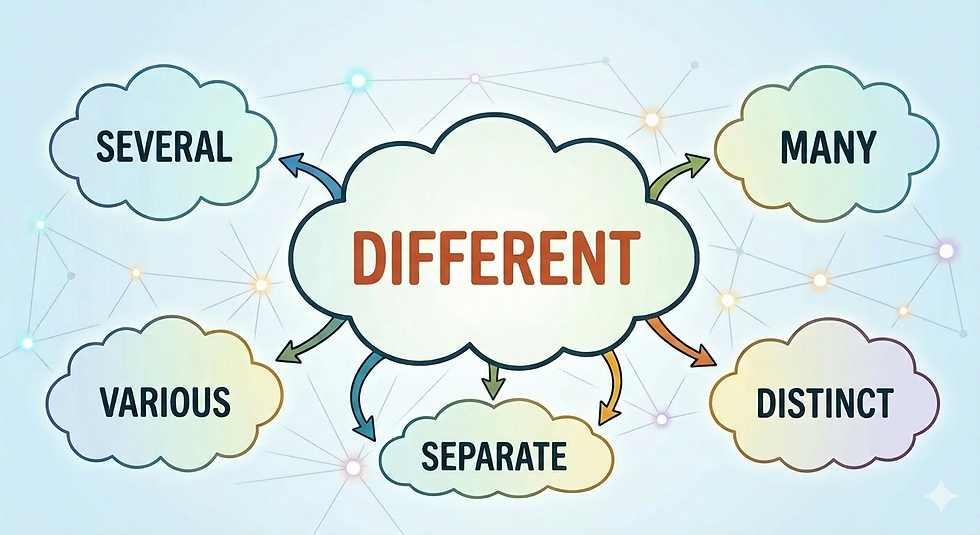
I've arrived at a litmus test for different that seems to work: Replace different with "not identical" or "non-identical" in the sentence. If the intended sense is conveyed (though the resulting sentence may not read well), different is correctly used in the sentence. (Note: Later, I found this in The New York Public Library Writer's Guide to Style and Usage: "Copperud suggests that different should be omitted in a sentence if unlike cannot be substituted for it." The reference is to the classic American Usage and Style: The Consensus by Roy H. Copperud.)
With this background, let's analyze the above sentences one by one. In (1), (3), and (4), replace different with various, because "not identical" does not convey the intended meaning. In (2) and (10), delete different on grounds of redundancy. Sentences (6), (7), and (9) illustrate the correct use of different; the intended meaning in each case is "non-identical." The same pricing slab cannot be used for the three products: each product requires its own pricing slab. Similarly, each category must have its own color, and the rural market will need its own strategy.
That leaves sentences (5) and (8). In (5), context (the rest of the sentence, which we don't have) will tell us whether "various players" will suffice, as in (1), or whether the intended meaning is "diverse players." Even in the latter case, "different players" doesn't work: obviously, the players cannot be identical, and in that sense, they are bound to be different from each other in some sense (if only their names). So, different here doesn't make sense; it's redundant. In fact, the only situation in which different is appropriate in (5) is when the intended meaning is that these players are different from other players that were mentioned earlier in the text.
Finally, let us turn to (8). Again, different is redundant; we need a better word. One solution is to replace different with two or three, as appropriate: "The viewpoints of the two generations of the family had to be taken into account" or "The viewpoints of the three generations of the family had to be taken into account." If the number of generations has been mentioned earlier, an alternative is "The viewpoints of all the generations of the family had to be taken into account."
One final example: "In India, the states of the Northeast face different challenges in ramping up development." Lacking more context, we don't understand what the author is trying to convey, but let's look at some possibilities. The word different is clearly misused in the sentence because "unlike challenges" doesn't make sense here. One possibility is "In India, the states of the Northeast face various challenges in ramping up development." Another possibility: "In India, the states of the Northeast face distinct challenges in ramping up development." That is, these states challenges that are different from those faced by other states. This sense could be emphasized even more strongly by replacing distinct with unique. Finally, if this is the intended meaning, the original sentence could be tweaked: "In India, the states of the Northeast face different challenges in ramping up development from those faced by other states." The phrase "different from" describes a comparison, and sometimes the word different could signal an incomplete comparison: the comparison must then be completed and made explicit as shown above. As we have seen earlier, Sentence (5) may be an incomplete comparison that could, for example, be remedied as follows: "The online gaming market attracted different players from the traditional ones mentioned earlier."
This innocent-looking word is the unprepared copyeditor's graveyard. However, those initiated into the mysteries of the word different know as soon as they encounter the word that they are standing next to a freshly dug open grave. Their concentration wonderfully improved by this knowledge, they are more likely to escape the fate of their unsuspecting colleagues—who have already passed into the afterlife though they do not know it.
"This innocent-looking word is the unprepared copyeditor's graveyard. However, those initiated into the mysteries of the word different know as soon as they encounter the word that they are standing next to a freshly dug open grave. Their concentration wonderfully improved by this knowledge, they are more likely to escape the fate of their unsuspecting colleagues—who have already passed into the afterlife though they do not know it."

As Well As. This is often used as a synonym for "and," but technically "X as well as Y" means "Not only Y but also X." That is, known information is paired with "as well as." So, "Tamil is spoken in Tamil Nadu as well as in some parts of Kerala" is incorrect; right is "Tamil is spoken in some parts of Kerala as well as in Tamil Nadu."
Plurals for Collective Nouns. In BrE, plurals are often used for collective nouns. In The Oxford Dictionary of American Usage and Style, Garner gives this example: "The board have considered the views of the shareholders." In AmE, the singular is invariably used for collective nouns: "The board has considered the views of the shareholders." This issue comes up frequently in business writing: "The company changed its recruitment policies, and they began considering elderly applicants for mid-level positions." In AmE, it would be "... and it began considering ..." As InE is based on BrE, Indian writers too tend to use plurals for collective nouns. The divide between the two variants of English is rather wide in this respect.
"The waters of the moat protecting BrE from AmE run dark and deep—and they sometimes run red. For example, on page 20 of The King's English, Amis declares: 'Not every Americanism deserves to have its credentials carefully examined. Some ought to be shot on sight.' Amis does not deign to mention Indianisms in his book; presumably they would be drawn and quartered on the spot."
In The King's English, Kingsley Amis writes in his acerbic style: "Grammatical parvenus get a lot of fun out of demonstrating they have learnt to count up to two by pouncing on plural subjects with singular verbs and vice versa. One favourite object of their uninstructed scorn is things like the headline "England Face Defeat" (at cricket, say). 'How can a singular noun like England take a plural verb like face?', they ask rhetorically. But "England Faces Defeat" means something quite different (in war?). Anyone with a tithe of wit knows that country-plus-plural refers to a sporting event, or something similar. This is precisely what the verb is doing in the plural. It shows that a number of individuals, a team, is referred to, not one thing: country."
Obviously, Garner has a very different opinion: "British English has gone so far in some contexts that many Americans would suspect a typographical error: 'Oxford were the winners of the 136th University Boat Race, but many will say that Cambridge were the heroes [Sunday Times, London]'."
The waters of the moat protecting BrE from AmE run dark and deep—and they sometimes run red. For example, on page 20 of The King's English, Amis declares: "Not every Americanism deserves to have its credentials carefully examined. Some ought to be shot on sight." Amis does not deign to mention Indianisms in his book; presumably they would be drawn and quartered on the spot.
Hyphenation. Many words that are hyphenated in BrE (and by extension, in InE) are closed up in AmE. I've learned to check each hyphenated word with Websters.com. The following words, taken from my practice, are closed up in AmE: anti-competitive, co-financed, co-founder, co-wrote, counter-terrorism, home-grown, inter-ministerial, intra-city, mid-year, multi-location, multi-stage, multi-stakeholder, multi-faceted, multi-level, multi-step, multi-tiered, multi-sectoral, multi-year, non-agricultural, non-bank, non-banking, non-enforcement, non-farming, non-financial, non-functional, non-motorized, non-standard, non-transparent, pre-approve, pre-empt, pre-existing, re-use, re-engineering, semi-retirement, socio-economic, socio-cultural, spatio-temporal, sub-process, take-out, under-utilization, and semi-public. Healthcare, however, is health care in AmE. And words like pre-existing are hyphenated in APA style, so check the applicable style guide too.
Superfluous Prepositions. In "renamed as," "discussed on," "emphasized on," "stressed on," "lacked in," and "considers as," the preposition should not be used in each case. Thus, it is "My mother considered Calcutta the best city to live in" and not "My mother considered Calcutta as the best city to live in."
Numbers. Lakhs and crores should be converted to hundred thousands, millions, billions, or trillions (lakh crores), as appropriate. This much is obvious. What is often overlooked is the punctuation of numbers. For example, 1,50,000 looks strange to a non-Indian; we read it as one lakh fifty thousand, but the commas look all wrong to non-Indians. All such numbers should be punctuated in accordance with the international numbering system (150,000 in this case). Numbers should be punctuated correctly not only in text but also in figures and graphs.
Local Terms. Terms with a local flavor such as "Tier-I city," nullah, and pucca should be explained in a footnote or endnote.
BrE/AmE/InE Differences. "Chartered accountant" may not be understood by a US reader. An endnote/footnote could explain that it means "certified public accountant." A "graduate program" in the United States is what we call a "postgraduate program" here. Batchmate is an Indianism; classmate is used in the West. Office-bearer and remit are not used in AmE; prefer officer and responsibility. Regimen is not used in BrE; regime is invariably used. In AmE, regimen is used in the contexts of diet and medicine; in political and organizational contexts, however, it is regime, e.g., "the sanctions regime." The usage of film and movie deserves a separate blog post. AmE uses "fiscal year," but BrE uses "financial year." It's "main street" in AmE and "high street" in BrE, "cell phone" in AmE and "mobile phone" (but "mobile apps" is fine in AmE), "tick" in BrE and "check" or "check mark" in AmE. This is a long and never-ending list!
Living in Multilingual India: Our Enduring Strength. We Indians live in one of the most multilingual societies in the world, learning three languages in school and becoming fluent in even more languages as we crisscross the country for work and pleasure. Juggling multiple dialects of English should come easier to us than to most others. The language-switching mindset is ingrained in us. But mindset is not knowledge, and as I've tried to show above, this is one area where the learning never ends.


Quite brilliant!
Wow in depth written article but You omitted a zero in the parentheses